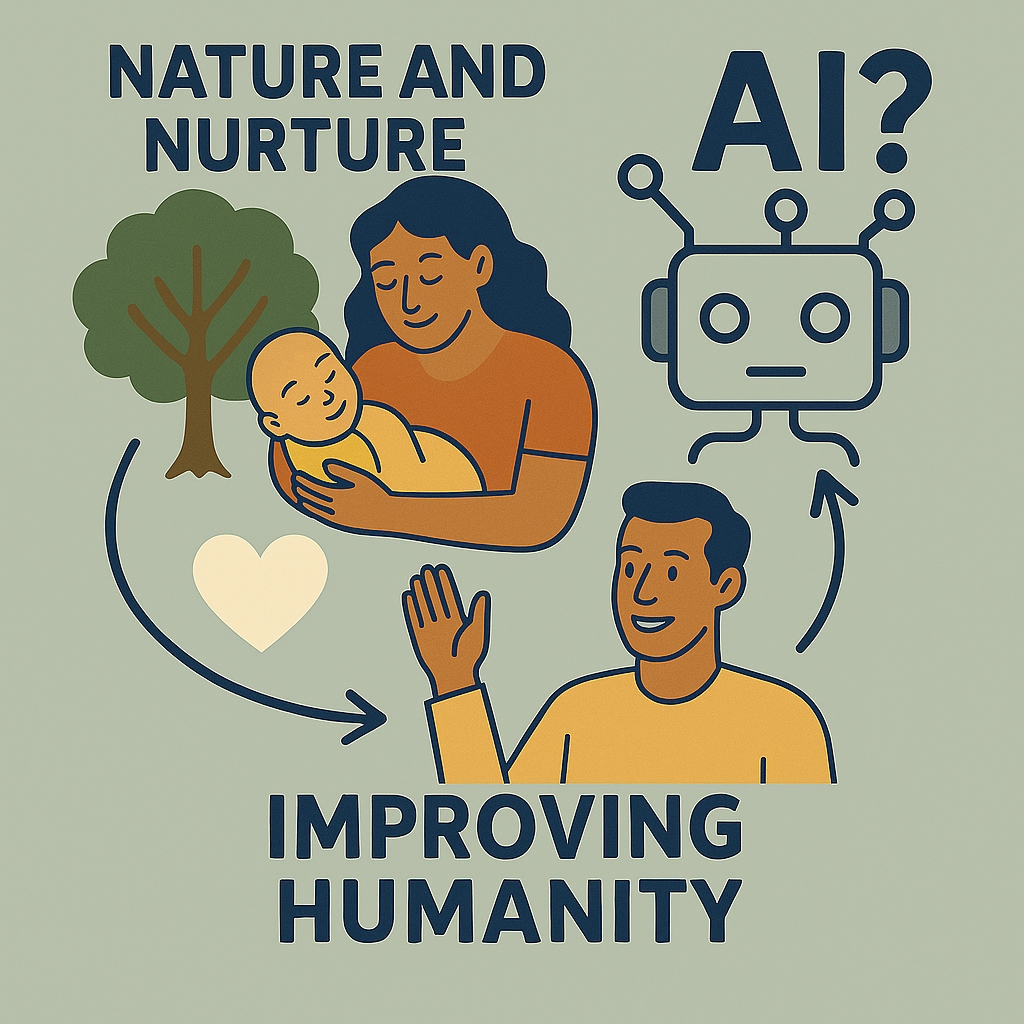
Following a thought-provoking article by my colleague, Dima Wadjih | LinkedIn, I have been inspired to write this blog. Dima’s article sits in AI philosophical academia and gave me another opportunity to grow intellectually and learn about new areas that build on my passion for teaching sensory experiences. Personal proof AI is not making me less intelligent but fuelling my growth mindset. I am hoping this is the same for many using AI.
For years, it’s been debated whether the complexities of Nature (our environment) or Nurture (our family) shape who we are.
Now, a third force is transforming this complex conversation, Artificial Intelligence. AI doesn’t just change how we work but influences how we learn, make decisions, and define human potential.
Dima references, ‘the ghost in the machine’, a tendency to ascribe consciousness or intention to something purely mechanical.
Dopamine digital addiction
What is dopamine. This is a chemical neurotransmitter our brain uses to signal things like attention, learning, motivation, and what feels important. It can also act as a hormone in our body. However, dopamine in relation to technology refers to how novelty, surprise, or a usefulness trigger to our brain.
With the guidance of Copilot Researcher, started to understand how neurotransmitters like dopamine can fuel addictive online behaviour and how this can be multiplied by free chatty generative AI tools like Copilot, ChatGPT and more.
Dopamine research risks, “The relationship between dopamine and digital addiction has become one of the most pressing psychological phenomena of our time. We carry dopamine-dispensing devices in our pockets!”
And more, “Engaging in late-night scrolling despite feeling physically tired often leads to feelings of tension. On a dopamine emotional level, this can cause a sense of dissatisfaction, even after rewarding activities like exercise – as can trigger poor sleep with something lingering in our minds that we read online.”
The integration of modern technology, especially artificial intelligence, has significantly increased the stimulation of our dopamine pathways. This heightened stimulation is not only due to the usefulness of these tools but also because of the psychological mechanisms at play. Repetition, false trust, and a decline in critical thinking all contribute to the influence that AI comes into play with our mindful behaviour.
Reliance on AI can undermine judgment by skipping fact-checking.
Another irritating example is those who post unedited AI responses in social media marketing content!
And those who believe AI is a friend who truly understands us on a personal level!
“AI output is nothing more than an aggregated reflection of collective linguistic behaviour.” Dima.
Good dopamine AI interactions
When it supports learning, focus, and meaningful progress, for example, when an AI helps you understand something, think more clearly, or move a real task forward. It becomes less healthy when the interaction is driven by constant novelty, quick reassurance, or endless checking, where the reward comes from engagement itself rather than effort or integration.
Crafting this article has been a dopamine-rich experience — refining ideas, fact-checking, and shaping it in my own tone of voice. But it’s serotonin that truly rounds out the day, following a trip to the gym this morning, walking the dogs by the sea this afternoon with my husband. These are moments AI can never replicate.
Source: The ghost in the machine | LinkedIn Dima
Source: The reward circuit: dopamine and digital addiction
Source: Dailyom
 Sensai~teacher of AI
Leave a comment