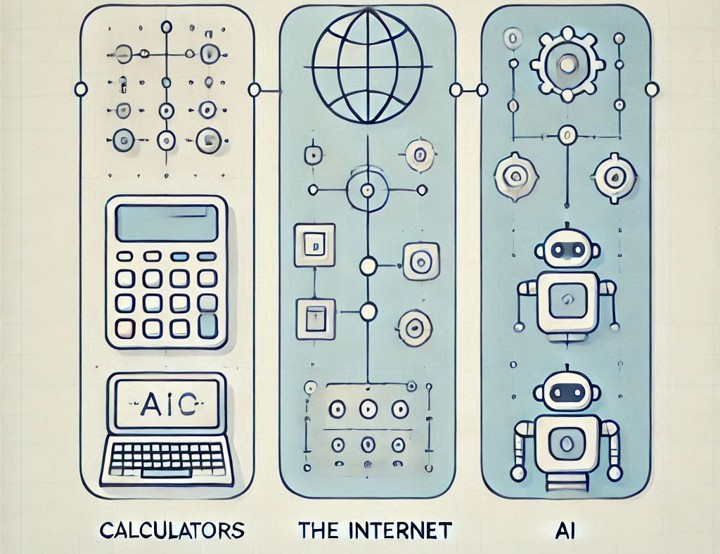
I asked ChatGPT to generate observations on how the calculator, email and the internet have impacted society, and forecast AI impact on society. I then requested ChatGPT to include observations from Claude AI and summarise. I copied and pasted the responses into a Word doc and refined. I also created an image with Microsoft Designer using the prompt at the end of this AI assisted blog. This has been a thought provoking but speedy process of which enabled me to research the impact on society of major tech innovations and consider appropriate upskilling behaviours for the future.
The evolution of technology has profoundly shaped education, industries, and daily life, with calculators, the internet, and artificial intelligence (AI) standing out as transformative milestones. Here’s a closer look at their impacts, challenges, and future implications:
1970’s Calculators – Simplifying Complexities: Maths, Education. Calculators revolutionized mathematical problem-solving by enabling quick and accurate computations. They became indispensable in education, scientific research, and various industries. While some educators worry about over-reliance on calculators, many highlight their role in fostering higher-order thinking by shifting the focus from manual computation to problem-solving.
1980’s-90’s Email – Revolutionizing Communication. Email transformed professional and personal communication, introducing instant, documented exchange of messages and files across any distance. It revolutionized workplace dynamics by enabling asynchronous collaboration, remote work possibilities, and efficient information sharing. However, it also brought challenges like information overload, the expectation of constant availability, and security concerns with phishing and spam. Email became the backbone of digital professional communication, though its dominance has evolved with the rise of instant messaging and collaboration platforms.
1990’s Internet – Bridging Worlds: Communication, Information, Commerce. The internet democratized access to information, fostering global connectivity and innovation. However, it also introduced challenges like information overload and misinformation. As users navigate this vast digital landscape, digital literacy has become essential for discerning credible sources. The internet has reshaped industries, enabled social movements, and revolutionized communication, but its rapid growth demands a balance between its benefits and ethical usage.
2020’s Artificial Intelligence – The New Frontier: Automation, Decision Making, Creativity. AI promises unparalleled advancements across sectors, from personalized education to precision healthcare and sustainable resource management. Yet, it also raises significant concerns:
- Employment: AI-driven automation could displace millions of jobs, sparking calls for proactive worker retraining programs to ease the transition to new economic realities.
- Ethical Challenges: Instances of algorithmic bias highlight the need for robust ethical guidelines to ensure fairness and equity.
- Environmental Impact: The energy-intensive nature of AI and digital technologies contributes to a growing carbon footprint, urging a shift toward sustainable practices.
In education, AI’s integration parallels the adoption of calculators. While it streamlines tasks and personalizes learning, educators must balance its use with the development of foundational skills.
A Holistic Approach to Technology Adoption. Calculators, Email, the Internet, and AI have the transformative power to enhance efficiency, democratize access, and drive innovation. However, their integration into society necessitates thoughtful consideration of ethical, economic, and environmental implications. By following responsible use and addressing challenges head-on, we can harness their potential to create a more equitable and sustainable future, particularly in medical research, climate change and creativity!
Here are some steps consumers can take to adopt and benefit from AI effectively.
1. Identify Your Needs. Determine the areas where AI can help, such as personal productivity, financial management, shopping, entertainment, or health. For example, use AI to organize schedules, automate repetitive tasks, or provide recommendations.
2. Choose Reliable Tools and Platforms. Research and select trusted AI applications and devices (e.g., virtual assistants like Alexa, chatbots, and AI-based apps for fitness or budgeting). Ensure they come from reputable developers with good reviews and privacy policies.
3. Educate Yourself on AI Features. Learn about the features and capabilities of your AI tools, such as voice recognition, recommendation engines, and predictive analytics. Familiarize yourself with how to customize settings to optimize performance.
4. Start Small. Begin with simple tasks, such as using voice commands for a virtual assistant, AI-powered navigation apps, or automated email responses. Gradually explore more advanced features like smart home devices or AI-generated financial insights.
5. Maintain Privacy and Security. Understand how AI applications collect and use your data. Opt for tools that offer robust privacy controls and use strong passwords or two-factor authentication.
6. Explore AI-Driven Content and Services. Use AI for content creation (e.g., text-to-speech, image generation, or photo editing). Take advantage of AI services for personalized recommendations (e.g., shopping platforms, streaming services, or online learning tools).
7. Stay Updated. Keep your AI tools and devices updated to access the latest features and security patches. Follow developments in AI to discover new ways it can enhance your life.
8. Provide Feedback. Many AI tools learn from user interactions. Providing feedback (e.g., rating suggestions or correcting errors) helps improve their accuracy.
9. Balance Automation with Control. Use AI to automate repetitive tasks but retain control over important decisions. Avoid over-reliance by cross-checking critical AI-generated outcomes.
10. Experiment and Innovate. Explore creative ways to use AI for hobbies, personal projects, or even small businesses.
• Experiment with tools like AI design software, writing assistants, or financial modeling apps.
By taking these steps, consumers can make the most of AI’s potential while maintaining control over their digital lives.
Note: Microsoft Designer AI assisted prompt: Generate clean, simple image illustrating the impact of calculators, the internet, and AI on society. Timeline with three distinct sections: one for calculators, one for the internet, and one for AI. Each section includes relevant icons and symbols, such as a calculator, a computer, and a robot, respectively. Background is light and minimalistic, with subtle gradients and soft colours. The overall mood is informative and educational, highlighting the progression and influence of these technologies on society.
 Sensai~teacher of AI
Leave a comment